Bad breath is among those issues that individuals tend to deal with in a low profile manner. Mint, mouthwash, or a chewing gum might appear as a make-shift solution, yet when the smell keeps coming back and particularly in a few hours then it is likely that there is something more underlying. Chronic bad breath (medically known as halitosis) is not only a social menace. As a rule, it is an indicator of a dental issue that requires quality care over a short-term, short-term hiding.
We often come across patients at The Dental Venue complaining that they brush their teeth twice per day yet their breath does not feel fresh. It happens to be a very common scenario and one should realize that brushing is not always the solution to the root cause. When bad breath has become the norm, visible to people, or affecting your confidence, then it is time to consider the dental reasons you should not overlook
Why Bad Breath Happens (And Why It Keeps Coming Back)
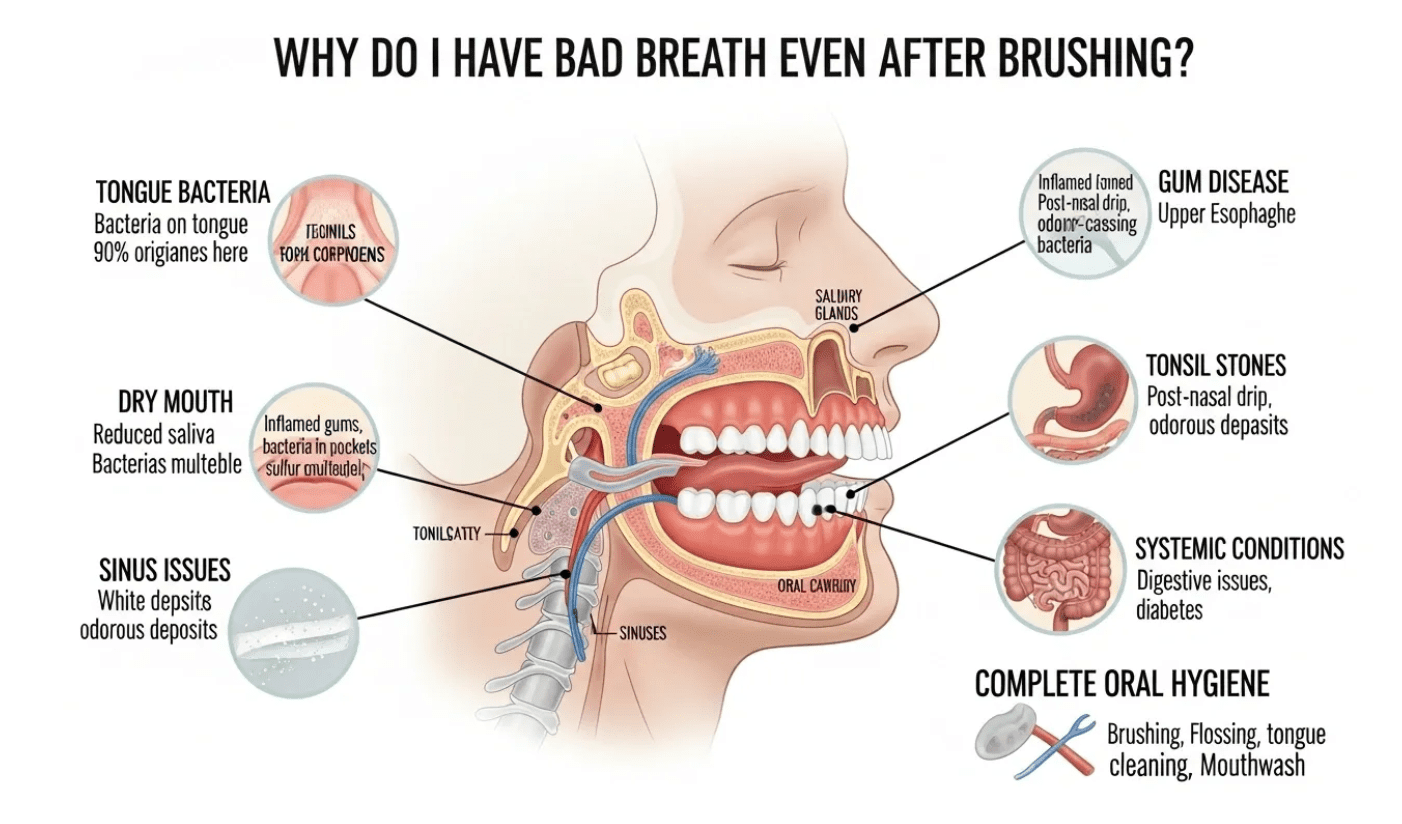
Volatile sulphur compounds (VSCs) are usually the cause of bad breath as these gases are formed when bacteria decompose mouth proteins. These bacteria multiply in places where dead cells, plaque and food particles congregate. The smell might be subtle initially, however, when the source is not disposed of, it turns long lasting.

One of the mistakes that people make is this: mouthwash does not get rid of the root cause of bad breath that is chronic. It can temporarily decrease smell, but not eliminate tartar deposits, gum infection, or tooth decay. The problem is still there in case the smell returns so fast.
Dental Reasons for Bad Breath That Won’t Go Away
1) Gum Disease (Gingivitis and Periodontitis)
Among the biggest causes of constant halitosis that is also one of the least recognized, is gum disease.
- Gingivitis is the condition of gums being inflamed due to the plaque buildup.
- Periodontitis is a more serious condition when the infection goes through and affects the tissues of gums and bone supporting the teeth.
When the gums get infected, bacteria increase in gum pockets and thus, they emit foul odour gases. Sometimes, this results in a strong and terrible odour which cannot be solely eliminated by brushing.
Gum-related bad breath signs are you:
- Gums that bleed during brushing or flossing
- Gums that are swollen or painful
- Unceasing bad taste in the mouth
- Gums are receding and teeth are getting separated
- Pus discharge from the gumline (extreme cases)
Halitosis caused by gum disease isn’t just a cosmetic problem, but it indicates infection. If left untreated, it can result in dental mobility and eventually loss of teeth.
2) Tooth Decay and Cavities
In the initial phases, cavities don’t necessarily hurt. Pieces of food can get caught in the cracked spots, and bacteria break them down, producing a foul odor.
The tooth affected by the decay may show:
- A dark spot or hole that can be seen
- Sensitivity to cold or sweet foods
- Pain while chewing (later stages)
- Bad breath that stays after brushing
Sometimes the patients only discover a cavity when it is already deep. In some cases, persistent bad breath may be the indication that decay still hidden is advancing.
3) Food Stuck Between Teeth (Especially in Tight Contacts)
Even brushing thoroughly, you may still find that food is getting stuck between your teeth, especially:
- in between molars,
- under the fillings which are not shaped well,
- around crowns or bridges,
- near orthodontic brackets or retainers.
When trapped food rots, it releases a foul smell and provides a perfect environment for bacteria to multiply. Often, a toothbrush alone is not able to get rid of it thoroughly.
Which is why flossing should be done regularly and not left out of the routine. Someone could wipe their teeth two times a day and still face the problem of the bad breath merely because plaque and food have become lodged between the teeth.
4) Tongue Coating (A Major Source Many People Ignore)
The tongue is covered with a textured surface having tiny crevices which can trap bacteria, dead cells, and food particles. A heavy coating on the tongue is considered one of the major causes of the unpleasant breath that is difficult to get rid of.
People who have a coated tongue are usually those individuals who:
- Breathe through the mouth
- Drink less water
- Smoke or use tobacco
- Consume a lot of tea/coffee
- Have bad oral hygiene habits
Cleaning the tongue daily with a tongue scraper as a simple measure can greatly contribute to decreasing the odour. Nonetheless, if the coating recurs rapidly and the smell continues, a dental evaluation is still vital..
5) Dry Mouth (Xerostomia)
Saliva basically serves as the mouth’s natural cleaning agent. It plays a significant role in removing food particles, neutralizing acids, and controlling the bacteria to some extent. If the saliva flow is reduced, bacteria will be able to reproduce more rapidly, and the issue of bad breath will be more noticeable.
Dry mouth can result from:
- Dehydration
- Breathing through the mouth
- Smoking
- Certain medications (e.g., allergy meds, antidepressants, blood pressure drugs)
- Stress and irregular sleeping patterns
Those who suffer from dry mouth tend to have unpleasant breath in the morning which lasts all day. Simply drinking water is not the answer; the underlying cause may need to be treated as well as oral hygiene improved.
6) Infected Wisdom Teeth or Partially Erupted Teeth
Partially erupted wisdom teeth will usually cause the formation of a gum flap, which in turn, becomes a perfect spot for food and bacteria to get trapped. The infected cancer (pericoronitis) may cause symptoms such as swelling, pain, and very unpleasant breath.
Typical symptoms are:
- Bad-smelling breath accompanied by an unpleasant taste
- Swelling near the cheekbone area
- Pain when biting
- In more advanced cases difficulty in opening the mouth fully
Usually, the treatment for this problem includes professional cleaning of the area, antimicrobial therapy if the infection is present, and removal of the wisdom tooth in some cases.
7) Poorly Fitting Dental Work or Old Restorations
Dental crowns, bridges, and fillings are meant to protect teeth not trap bacteria. But if they are old, broken, or poorly fitted, they can create tiny gaps where plaque accumulates.
This can result in:
- Persistent odour
- Gum inflammation around the restoration
- Food packing in the same area repeatedly
In such cases, no amount of mouthwash will solve the issue. The dental work may need adjustment or replacement.
8) Dental Infections and Abscess
A dental abscess is a pocket of pus due to bacteria infection, usually resulting from deep decay or gum disease. The smell of breath because of an abscess can be very strong and it is generally accompanied by other symptoms.
Warning signs of infection include:
- Throbbing toothache
- Swelling in the gum or face
- Pus discharge
- Fever or general weakness (in some cases)
- Bad taste that comes and goes
This is not something to delay. Dental infections can spread if left untreated and require urgent care.
What You Can Do at Home (That Actually Helps)
Though a professional diagnosis is essential when dealing with a persistent bad breath problem, the following habits are really effective:
- Brush your teeth for at least 2 minutes twice a day
- Use a soft brush and make sure to clean along the gumline
- Floss daily (molars are especially important)
- Brush your tongue daily
- Drink water regularly throughout the day
- Avoid eating sugary snacks frequently
- Don’t rely on mouthwash only
- Change your toothbrush every 3 months (or if it is frayed, even sooner)
If you change your habits and the smell still comes back, this is a very strong indication of a dental problem.
When Bad Breath Needs a Dental Check-Up
You should see a dentist if:
- Your bad breath keeps getting worse or lasts for over 2-3 weeks, even if you keep good hygiene.
- There are bleeding gums, swelling, and gum recession where the gums seem to shrink away from the teeth.
- You think you might have cavities or your teeth feel sensitive.
- The taste in your mouth is unpleasant persistently.
- You have pain in the tooth when you bite, or your tooth is loose.
- Dryness of your mouth is a condition that you feel constantly.
- A person who is close to you habitually perceives your smell.
Only a professional dental check-up can reveal the accurate reason, whether it is periodontal disease, caries, inflammation, or accumulated plaque that needs to be removed by scaling.
Professional Treatment Options (Depending on the Cause)
A dentist might suggest:
- Through scaling and polishing, plaque and tartar can be removed
- Deep cleaning (root planing) is done in case of gum pockets
- Cavity fillings or replacement of old restorations
- Root canal treatment of the infected tooth
- Treatment of wisdom teeth if there is an infection
- Advice on how to deal with dry mouth and improve oral hygiene
It’s not only about getting fresh breath, but also about restoring your oral health and preventing problems in the future.
Final Thoughts
Perennial bad breath is hardly a mouthwash issue. It is in most instances an indicator that something is growing somewhere in the mouth most likely as a result of gum disease, concealed decay, tongue coating, dry mouth, or infection. The only permanent solution is the treatment of the source. After you have made efforts to brush better and the smell still lingers, please do not ignore it and be ashamed of seeing a dentist. An initial dental check up will help you to stay away from more serious problems later and achieve a feeling of comfort and confidence again.To achieve a comprehensive diagnosis and proper treatment plan, one can refer to The Dental Venue where they only focus on fixing the underlying cause rather than treating the symptoms.