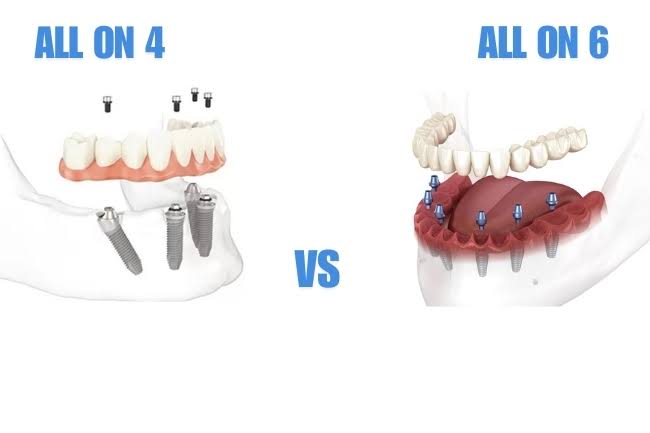
With less than perfect or nonexistent dentition, either All-on-4 implants or All-on-6 implants remove an entire dentition and replace it with a permanent set of arch teeth that are attached to 4 or 6 titanium implants, where the only determinant is the number of implants placed and the quantity of bone support present. All-on-4 is a system comprised of 4 implants that are tilted to function with less bone, and usually cheaper, whereas All-on-6 is a system of 6 implants for additional stability, which is often needed when greater chewing force or insurance of and against bone support is required. None is definitely “best”, this will depend on the design of the jawbone, bite power, and the budget.
How All-on-4 Works
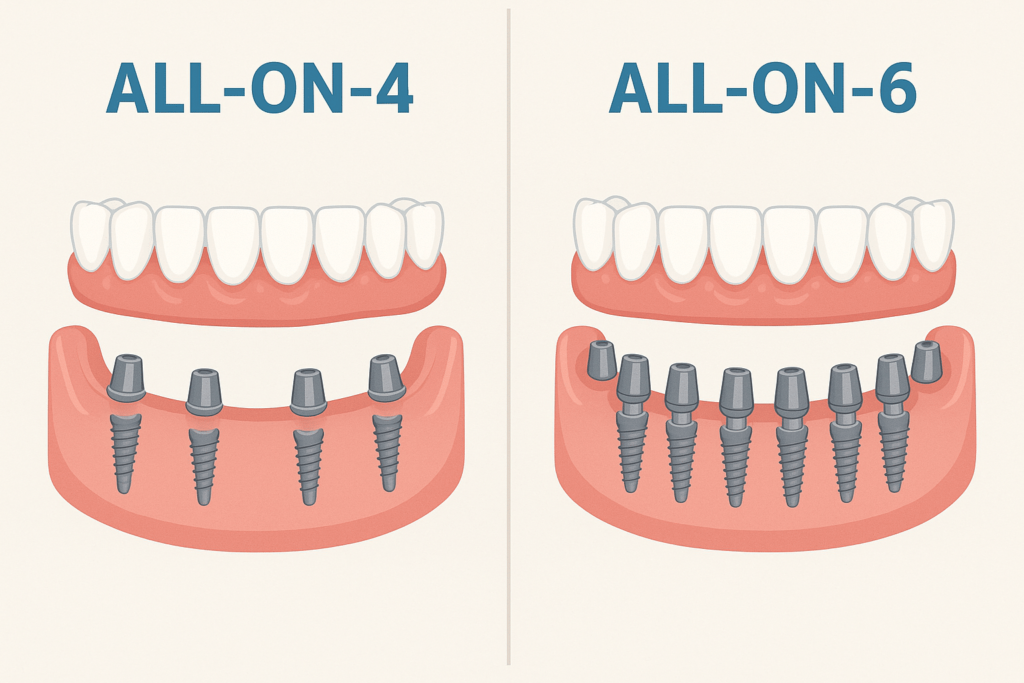
All-on-4 requires four implants per arch, two of which must be positioned vertically towards the front and the other two must be tilted backwards and away from the sinus cavity/nerve to maximize bone contact. That’s the reason All-on-4 was created in the first place: to attach to the angulated area in patients who have moderate bone loss without needing to perform bone grafting, thereby cutting down on treatment time and expenses. These four implants support a full arch of rigid dentures, so that bite force is divvied up evenly among the four.
Best Candidates
Best candidates are patients with mild bone loss who do not want to have the surgery grafted, and patients who want to avoid expensive surgery, but have a fixed result in mind (where the bridge is not removable).
How All-on-6 Works
The principle behind All-on-6 is similar to the concept of a fixed arch of teeth supported by implants, although six implants are used instead of four. The two extra implants are normally fed into the area of the tooth known as the pre molar area distributing chewing load over more anchors. This typically involves a higher amount of available bone density, or possibly a small procedure known as grafting in order to make the site site.
Best Candidates
Best candidates – people with good bone volume, patients who grind their teeth, patients who have a strong bite force, anyone who wants the added security of extra support over the long term – especially in the lower jaw which is under greater forces.
Side-by-Side Comparison
Factor | All-on-4 | All-on-6 |
Cost | Faster — reduced preparation time and fewer implants | Higher – Two more implants and perhaps additional preparation required! |
Number of Implants | 4 per arch | 6 per arch |
Optimal Recommended For (Bone Density) | Moderate bone loss ——————————— angled placement avoids grafting | The amount of bone volume required for dental implants.The amount of bone required for a dental implant placement. |
Stability | The business’s strongest was the load supported by 4 points. | Lower, together with load distributed among 6 points — larger margin for bite strength. |
Timeline | Successful treatment is often faster on day of treatment | May require additional time to plan/heal in case any grafting is needed |
What About “Implants in 72 Hours”?
Having a same day load or immediate load situation in place is real and clinically proven, however for this to happen it has to be an explicit part of the process and not automatic for anyone, even with the same system. Immediate loading requires the placement of the implant and then the temporary up-fitted fixed bridge rather than waiting for the typical 3-6 months needed for implant osseointegration (bone fusing to the implant) before the final prosthetic is to be fitted.
This will depend on measurable variables such as adequate bone density and volume at the site of the implants, proper primary stability (determined by torque and stability measurements during surgery, and no presence of primary infection or uncontrolled factors such as unmanaged diabetes or bite pattern that would over time place undue pressure on the implants before they have become firmly attached. If any of these conditions are not fulfilled, it is possible that the implant will move within the jaw and result in a failure in the bone to fuse and become solid, formation of an infection, or both.
In a nutshell, a same day timeline is a potential result of a very good surgical assessment but not necessarily something promised before you undertake the assessment. The right clinic will be trying to look at your bone scans and bite first, not give you a timeline!
Who Should Choose Which?
Choose All-on-4 If
If you are concerned about cost and don’t need to wait for bone grafting, then All-on-4 may be the right option for you if you have moderate bone loss.
Choose All-on-6 If
Consider All-on-6 when you have healthy teeth and adequate bone volume, or if you grind your teeth, have good bite force, or desire the utmost in long-term stability.
Either way, a 3D scan and bite assessment in consultation (which was never marketed as a protocol) should dictate the case.
Frequently Asked Questions
Is it possible to have a full mouth dental implant in one day?
Often the procedures to place the implant can be performed in a single visit and if your bone quality and stability testing parameters are acceptable, a temporary fixed bridge can be attached that same day. This is the final, permanent prosthetic – which is added afterwards, once healed.
But what if there wasn’t enough jawbone?
An All-on-4’s angled implant placement may be possible without grafting, or a bone graft may be needed to make the site stronger to provide All-on-6. This will be confirmed by imaging by your surgeon.
So how long does it last with All-on-4?
The implants can endure for decades, the attached “teeth” every 10-15 years due to normal wear.
Get Ready To Find Out Which Option Fits You?
The best way to determine which of the two types of treatment is ideal for you and your mouth is to have a proper scan and consultation. Schedule a full mouth restoration consultation with The Dental Venue and receive a customized estimate and plan for cost, as well as treatment, options.
Dental Implants as a Permanent Tooth Replacement
Implants replace defective or missing teeth, serving as the foundation for new, permanent ones.The Dental Implant has been designed to replace missing or flawed teeth and are used respectively as the base for new permanent teeth.